
Erling Haaland was already one of football’s biggest stars before the 2026 World Cup. Now, with Norway back on the global stage, the Manchester City striker has added another chapter to his remarkable story.
Born in Leeds, England, and raised in the small Norwegian town of Bryne, Haaland has become one of the most recognisable sports stars on the planet.
His blend of size, speed, strength, movement, and ruthless finishing has made him a nightmare for defenders and a dream for managers.
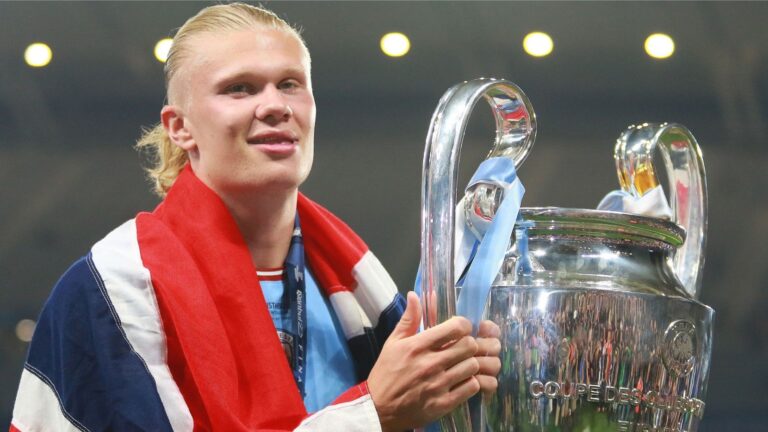
Every now and then, a footballer comes along from one of Europe’s smaller footballing nations who forces the world to pay attention.
For Norway, that player was once Martin Ødegaard, the teenage prodigy who signed for Real Madrid and later became Arsenal captain. Then came Erling Braut Haaland.
From Bryne to Molde, Salzburg to Dortmund, and now Manchester City, Haaland’s career has been a story of goals, records, and constant upward momentum. For Norwegian football fans, his rise has been especially exciting. Norway has produced many good footballers, but few true global superstars.
Haaland is different. He is not just a famous Norwegian footballer. He is one of the defining players of his generation. Here are 15 fun facts about Norway’s goal machine.
Quick Erling Haaland Facts
Full Name: Erling Braut Haaland
Date of Birth: 21 July, 2000
Place of Birth: Leeds, England
Citizenship: Norwegian
Height: 1.94 m (6 ft 4 in)
Position: Striker
Current Club: Manchester City
Previous Clubs: Bryne FK, Molde FK, Red Bull Salzburg, Borussia Dortmund
1. He scored twice on his World Cup debut
For years, one of the strange things about Erling Haaland’s career was that he had never appeared at a major international tournament.
That finally changed at the 2026 FIFA World Cup, when Norway returned to the men’s tournament for the first time since 1998. Haaland made his World Cup debut in Norway’s opening group game against Iraq and, of course, he scored. Twice.
Norway won the match 4-1, with Haaland scoring both of his goals in the first half. It was a landmark moment for the player and for Norwegian football. After years of frustration in qualification campaigns, Norway finally had its two global stars, Haaland and Martin Ødegaard, on the World Cup stage.
Haaland had already done plenty to get Norway there. During qualification for the 2026 tournament, he scored 16 goals, an astonishing return that underlined his importance to the national team.
For a country that had waited 28 years to return to the World Cup, Haaland’s debut felt like much more than just another match. It was the moment Norway’s new football generation truly arrived.
2. He once scored nine goals in one match for Norway
Long before his World Cup debut, Haaland had already made headlines in a Norway shirt.
In 2019, while playing for Norway at the FIFA Under-20 World Cup in Poland, Haaland scored nine goals in a single match against Honduras. Norway won 12-0, but it was Haaland’s individual performance that made international headlines.
It remains one of the most eye-catching scoring feats in FIFA competition history. Even more remarkably, those were the only goals Haaland scored in the entire tournament.

Norway did not progress beyond the group stage, but Haaland still finished as the tournament’s top goalscorer. That tells you everything you need to know about how extraordinary that one match was.
At the time, many football fans outside Norway were only just beginning to learn his name. After that performance, it became much harder to ignore him.
3. He is already Norway’s all-time leading goalscorer
For many decades, the name at the top of Norway’s goalscoring charts was Jørgen Juve. He scored 33 goals for Norway between 1928 and 1937, a record that lasted for an astonishing 90 years.
Haaland finally broke that record in 2024, when he scored twice against Slovenia. He was still only 24 years old.
By the time of the 2026 World Cup, Haaland had already taken his Norway tally to a level that would once have seemed almost impossible. At the time of writing, following his two goals against Iraq, he has scored 59 goals in 52 appearances for the national team.
That is an absurd record at international level. It is not just that Haaland scores goals for Norway. It is the speed at which he scores them.
For Norwegian football, that matters. Norway has often struggled to qualify for major tournaments, even when it has had talented players. Haaland’s presence changes expectations. Whenever Norway plays, there is now a sense that a goal can come at any moment.
4. He was born in England but raised in Norway
Although Haaland represents Norway, he was actually born in Leeds, England.
His father, Alf-Inge Haaland, was playing for Leeds United at the time, so Erling spent the first years of his life in England. But both his parents are Norwegian, and when he was still young, the family moved back to Norway.
Haaland grew up in Bryne, a town in Rogaland, about 25 kilometres south of Stavanger. Bryne is not one of Norway’s biggest or most famous towns, but it has become an important part of the Haaland story.
In interviews, Haaland often comes across as proud of his roots. He may be a global superstar playing in one of the world’s most-watched leagues, but his football journey began on the west coast of Norway.
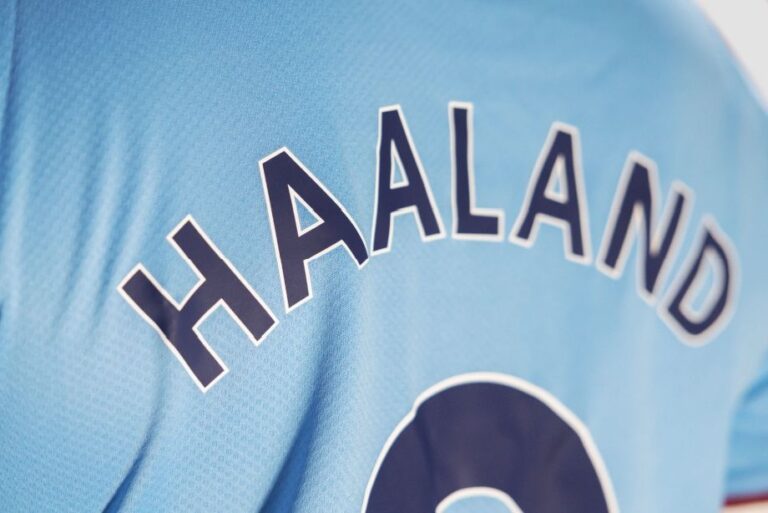
That mix of English birthplace and Norwegian upbringing is one of the many things that makes his story unusual.
5. He is beloved in Bryne
Bryne has fully embraced its most famous son.
Haaland began his football development at Bryne FK, joining the club’s academy before progressing to Bryne 2, the reserve team. He scored freely at that level, with 18 goals in 14 matches across the 2015 and 2016 seasons.
At just 15, he made his first-team debut for Bryne. He did not score in 16 senior appearances for the club, but his potential was obvious. Before long, Molde came calling.
Despite the fact he never scored for Bryne’s first team, the club and town still claim him proudly. Why wouldn’t they? Bryne was the place where Haaland’s football journey properly began.
In the years since his rise, Haaland fever has become a real thing in Bryne. Street art, visiting Manchester City fans, and media attention have turned the town into an unlikely stop for football tourists.
For most visitors to Norway, Bryne is not a typical destination. For Haaland fans, it has become part of the pilgrimage.
6. His father also played professional football
Erling Haaland’s football story is also a family story.
His father, Alf-Inge Haaland, was a professional footballer who played in England for Nottingham Forest, Leeds United, and Manchester City. He also represented Norway.
Alf-Inge was a very different kind of player from his son. While Erling is known for scoring goals, Alf-Inge was a defender and midfielder, valued for his toughness, work rate, and versatility.
For English football fans of a certain age, Alf-Inge Haaland is also remembered for his rivalry with Roy Keane, one of the Premier League’s most infamous storylines. But in the context of Erling’s career, the more important point is that he grew up around professional football.
He saw what it required. He understood the demands of the game from an early age.
There is no guarantee that the child of a professional footballer will become one too, let alone one of the best in the world. But in Haaland’s case, football was part of the family environment from the beginning.
7. He worked with Ole Gunnar Solskjær at Molde
After leaving Bryne, Haaland joined Molde, one of Norway’s most successful clubs.

At the time, Molde were managed by Ole Gunnar Solskjær. Best known internationally for his years at Manchester United, Solskjær had returned to Norway to build his coaching career and became an important figure in Haaland’s development.
Solskjær gave Haaland his first start for Molde in a Norwegian Cup match against Volda in April 2017. Haaland scored in a 3-2 win.
His first season at Molde was promising rather than spectacular. But in 2018, everything changed. Haaland scored 16 goals in 30 appearances in all competitions and finished as the club’s top scorer.
One match in particular made people sit up and take notice. Away to Brann in July 2018, Haaland scored four goals in the opening 21 minutes of a 4-0 win.
That performance felt like a statement. He was still a teenager, but the combination of power, pace, and finishing was already obvious.
8. He became famous in Europe at Red Bull Salzburg
Haaland’s next move took him to Austria, where he joined Red Bull Salzburg.
This was the stage on which he became known to a much wider football audience. Salzburg had already developed a reputation for identifying and developing young talent, and Haaland fitted perfectly into their high-energy attacking style.
Domestically, he scored goals at a startling rate. But it was the UEFA Champions League that truly introduced him to the world.
In the 2019-20 season, Haaland scored eight goals in six Champions League group-stage matches for Salzburg. He scored a hat-trick on his Champions League debut against Genk, then continued scoring against some of Europe’s biggest names.
He became one of the few players to score in each of his first five Champions League appearances. For a teenager playing for an Austrian club, that was extraordinary.
By the end of 2019, it was obvious he would not stay in Salzburg for long. Europe’s biggest clubs were watching.
9. Borussia Dortmund won the race to sign him
When it became clear that Haaland would leave Salzburg, some of the biggest clubs in Europe were linked with him.
Manchester United, Juventus, and others were all mentioned, but it was Borussia Dortmund who won the race. The move made sense. Dortmund had a strong reputation for giving young players minutes, responsibility, and a platform.
Haaland did not take long to make an impression in Germany.
On his Bundesliga debut against Augsburg in January 2020, he came off the bench and scored a hat-trick in just 23 minutes. It was almost comical. Most players need time to adjust to a new league. Haaland simply arrived and started scoring.
During his time at Dortmund, he became one of the most feared strikers in Europe. Across all competitions, he scored 86 goals in 89 appearances.
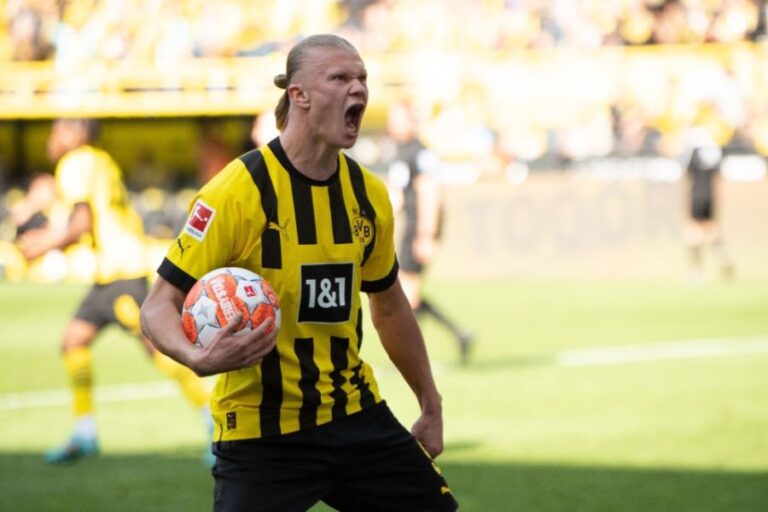
Those numbers still look outrageous. But with Haaland, outrageous numbers have become the norm.
10. His Manchester City contract now runs until 2034
In 2022, Haaland joined Manchester City.
It was a move that had long seemed possible. His father had played for the club, City needed a central striker, and Haaland was clearly ready for the Premier League.
The transfer was confirmed in May 2022, and Haaland officially joined City that summer. At first, he signed a five-year contract. But that detail is now out of date.
In January 2025, Manchester City announced that Haaland had signed a new 10-year contract, keeping him at the club until the summer of 2034.
Football contracts of that length are rare, especially at the very highest level. It was a huge statement from both club and player.
For City, it secured one of the world’s best forwards for the long term. For Haaland, it suggested he saw Manchester as the place to build the central years of his career.
Whether he stays for the full length of the deal remains to be seen. In modern football, almost nothing is certain. But the contract itself underlined his importance to Manchester City.
11. He broke the Premier League single-season goals record
Many players take time to adjust to English football. Haaland did not. In his first Premier League season, he scored 36 league goals, breaking the record for the most goals in a single Premier League campaign.
That record had previously been shared by Andy Cole and Alan Shearer, who each scored 34 goals in 42-game seasons. Mohamed Salah had also set the 38-game season benchmark with 32 goals. Haaland went past them all.
His debut season at Manchester City was remarkable not just because of the number of goals, but because of how quickly the records fell. Hat-tricks, braces, tap-ins, headers, penalties, first-time finishes: he scored in every way imaginable.
He finished that season with 52 goals in all competitions as City won the Premier League, FA Cup, and UEFA Champions League. It was one of the great debut seasons in English football history.
12. He reached 100 Premier League goals faster than anyone
As if the single-season record was not enough, Haaland later became the fastest player to reach 100 Premier League goals.
He reached the milestone in just 111 appearances, beating Alan Shearer’s previous record of 124 matches.
That is a stunning achievement, especially given the history of great Premier League forwards: Shearer, Thierry Henry, Sergio Agüero, Harry Kane, Wayne Rooney, Didier Drogba, and many more.
Haaland did not just join the 100-goal club. He got there faster than anyone else.
What makes the record so impressive is his consistency. Defenders know what he wants to do. Teams prepare specifically to stop him. He is analysed, marked, and targeted. And still he scores.
13. He became the fastest player to 50 Champions League goals
Haaland’s record-breaking has not been limited to domestic football. In the UEFA Champions League, he became the fastest player in history to reach 50 goals, doing so in just 49 games.
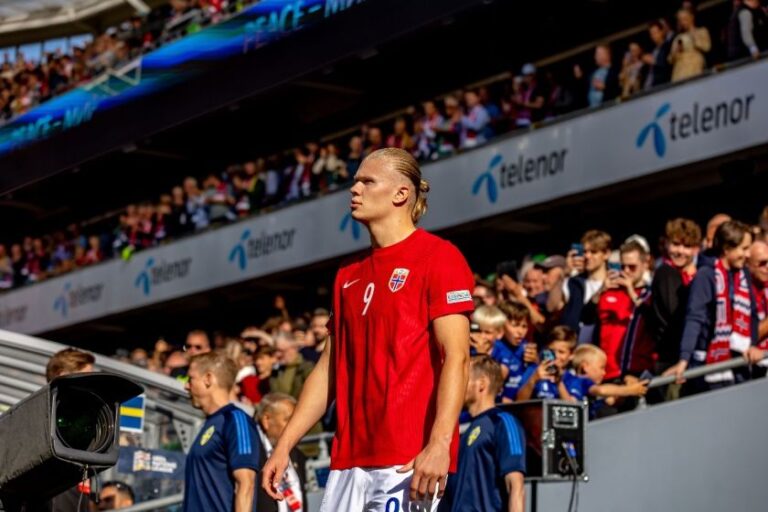
That is the kind of statistic that almost does not sound real. The Champions League is supposed to be the most difficult club competition in the world. It brings together elite defenders, elite coaches, and the highest-pressure matches in European club football.
Haaland has treated it like a personal scoring playground.
From Salzburg to Dortmund to Manchester City, he has scored consistently in the competition. His movement inside the box, ability to attack space, and calmness in front of goal have made him particularly dangerous in Europe.
Winning the Champions League with Manchester City in 2023 was a major moment in his career. But the individual scoring records suggest something even bigger: if he stays fit, Haaland could end his career among the greatest goalscorers the competition has ever seen.
14. He once recorded a rap track
Not all Haaland facts involve goals.
In 2016, long before he became a global football superstar, Haaland appeared in a rap video with two of his Norway youth teammates, Erik Botheim and Erik Tobias Sandberg.
The trio performed under the name Flow Kingz and released a song called “Kygo jo,” a playful tribute to the Norwegian DJ Kygo.
The video is exactly what you might expect from teenage footballers having fun: dancing, posing, playground scenes, and a lot of youthful confidence. Since Haaland became famous, the video has gained millions of views online.
It has become one of those internet artefacts that fans love to rediscover. Haaland the unstoppable striker is one thing. Haaland the teenage rapper is quite another.
It also adds a touch of normality to his story. Before the records, contracts, and global fame, he was just a Norwegian teenager making a silly music video with friends.
15. His routine is almost as famous as his goals
Haaland’s physical condition is a huge part of his success. At 1.94 metres tall, he is powerful in the air and difficult to knock off the ball.
But what makes him unusual is that he combines that size with explosive speed and sharp movement. He is built like a target man but runs like a sprinter. That does not happen by accident.
Over the years, Haaland has become known for taking nutrition, sleep, and recovery extremely seriously. He has spoken about eating high-quality food and has attracted attention for including foods such as heart and liver in his diet.
He has also been linked with routines involving filtered water, sunlight, blue-light glasses, ice baths, yoga, and careful sleep habits.
Some of this has contributed to his slightly robotic public image. Fans and journalists have called him a machine, a cyborg, and a monster, usually as compliments.
But behind the jokes is something important. Haaland’s career is not built on talent alone. It is built on preparation.
He seems to understand that elite football is not just about match day. It is about what you eat, how you sleep, how you recover, how you train, and how you stay mentally calm when millions of people are watching.
What's next for Haaland?
It is strange to write about “what’s next” for a player who has already achieved so much.
Erling Haaland has won the Champions League, broken Premier League records, become Norway’s all-time leading goalscorer, and signed one of the longest contracts in modern football. He has scored goals in Norway, Austria, Germany, England, Europe, and now on the World Cup stage.
And yet, he is still only in his mid-twenties. For Manchester City, the question is how many more trophies and records he can collect. For Norway, the question is even more exciting: how far can this generation go?
For years, Norwegian football fans had to watch major tournaments without their national team involved. That made Haaland’s rise feel almost bittersweet. Norway had one of the world’s best strikers, but the world had not yet seen him in a major tournament. The 2026 World Cup has changed that.
With Haaland leading the line and Martin Ødegaard pulling the strings in midfield, Norway suddenly has a team that neutrals want to watch.
There are still challenges, of course. International football is unpredictable, and one superstar striker does not guarantee success. But Haaland gives Norway something every team wants: a player who can change a match in a moment.
For a country better known internationally for winter sports, having one of the world’s biggest football stars is still a little surreal. But for anyone who has followed Haaland’s journey from Bryne to the world stage, perhaps it should not be surprising at all.
He has been heading in this direction for years.
Have you seen Erling Haaland play in person? I’d love to hear your thoughts on Norway’s superstar striker down in the comments.